50 Iconic Brands That No Longer Exist (2026)
From Blockbuster Video to Borders, a data-backed look at 50 beloved brands that disappeared—and why.

By Vanished Brands Research Desk
Introduction
Some of these names still survive in limited ways. Think trademarks, websites, licensed brands, or small remnants. But the version people actually remember, the one that shaped a category or an era, is gone.
Most iconic brands don’t die because people suddenly stop recognizing them. They die because something underneath the business breaks. In most cases, the same patterns show up again and again:
- Debt. Many chains were weakened by buyouts, bad acquisitions, or years of financial strain before the public noticed.
- Late digital pivots. Some companies saw the future coming but reacted too slowly.
- Category disruption. Streaming, smartphones, e-commerce, and social platforms rewrote entire industries.
- Mergers. Brand consolidation often pushed out less prominent products.
- Outdated business models. Products that became too difficult to replicate or maintain were usually shut down.
Retail
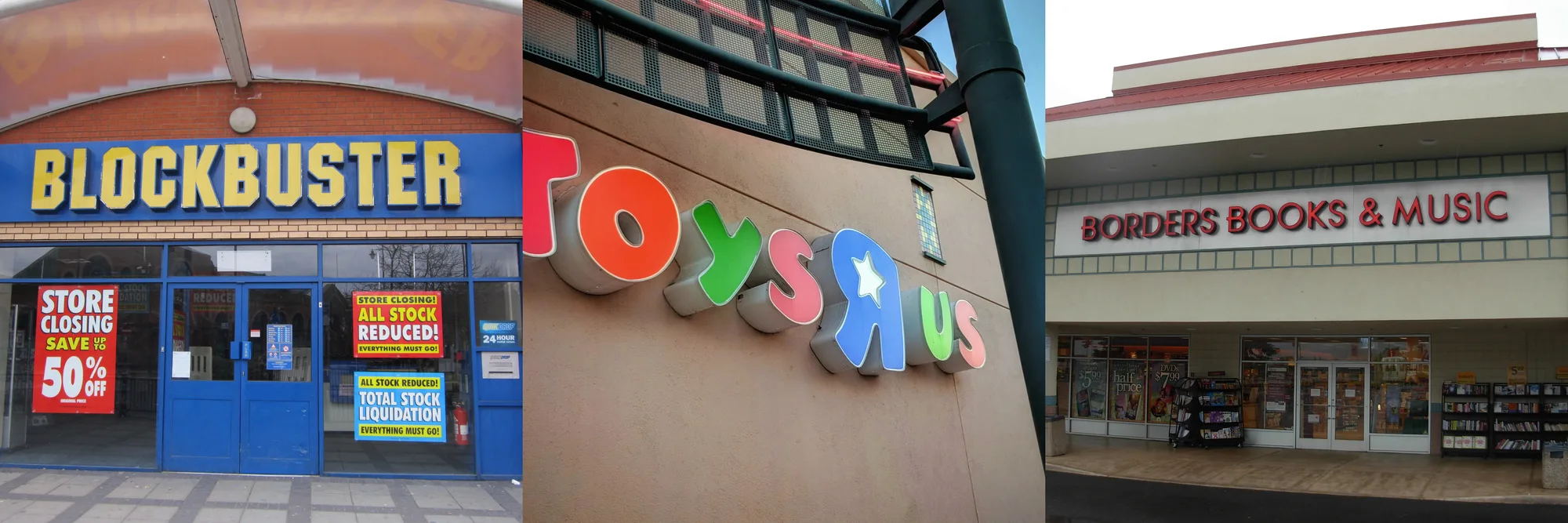
1) Toys R Us (1948–2018)
Known for: the giant toy superstore experience.
What happened: debt, e-commerce competition, and a late digital pivot broke the original chain. The brand later returned in a different form, but the old national big-box Toys R Us is gone.
Toys "R" Us
The biggest toy store in the world for kids growing up in the 1980s and 1990s, brought down by a massive debt load and competition from Ama…
2) Circuit City (1949–2009)
Known for: early big-box electronics retail.
What happened: service cuts, stronger competition from Best Buy, and weak online execution.
Circuit City
Electronics giant with 700 stores, beaten by Best Buy
3) Borders (1971–2011)
Known for: large bookstores with deep selection and café culture.
What happened: it outsourced e-commerce too long, overexpanded, and got squeezed by Amazon and e-readers.
Borders
Capture 11 bankruptcy in February 2011, followed by liquidation and closure of all stores later that year
4) Linens ’n Things (1975–2008)
Known for: home goods and bedding.
What happened: debt, recession pressure, and not enough separation from competitors.
Linens 'n Things
Bed Bath & Beyond's rival, died in the recession
Airlines
5) Pan Am (1927–1991)
Known for: glamour, global routes, and the image of the jet age.
What happened: deregulation, high costs, debt, and the damage that followed Lockerbie.
Pan Am
Iconic globe-trotting airline, filed bankruptcy in 1991
6) TWA (1930–2001)
Known for: transcontinental travel and the Howard Hughes era.
What happened: long-term financial weakness and eventual acquisition by American Airlines.
TWA
One of America's most famous airlines, known for its sleek planes, Jet Age glamour, and Howard Hughes, before going bankrupt and being abso…
7) Eastern Air Lines (1926–1991)
Known for: being one of the biggest U.S. carriers for decades.
What happened: labor fights, deregulation pressure, and mismanagement.
Eastern Air Lines
One of America’s original Big Four airlines, remembered for East Coast dominance, Florida routes, and a collapse that became one of the mos…
8) Braniff (1928-1982)
Known for: brightly colored planes, flight attendants in Pucci uniforms, glamourous.
What happened: deregulation-era competition, high fuel costs, and brand overexpansion.
Braniff International Airways
A stylish American airline founded in 1928 that became famous for bold design, colorful planes, and a glamorous jet age identity before goi…
Technology & Consumer Electronics
9) RadioShack (1921–2017)
Known for: parts, cables, hobbyist gear, and small electronics.
What happened: online competition, weak store experience, and years of identity drift. Read the full RadioShack story →
10) Palm (1992–2011)
Known for: PDAs and early smartphones.
What happened: it could not keep up with the iPhone and Android era.
Palm
Palm defined the PDA and helped shape the modern smartphone, but it lost when hardware became an ecosystem business instead of a device bus…
11) Pebble (2012–2016)
Known for: early smartwatches and Kickstarter momentum.
What happened: it ran into scale problems against much larger rivals and was acquired by Fitbit.
Pebble
A smartwatch that broke Kickstarter records in 2012 with a week-long battery and e-paper display, acquired by Fitbit for an estimated $30–4…
12) Zune (2006–2012)
Known for: being Microsoft’s iPod challenger.
What happened: Apple had already won the market and then moved the battle to smartphones.
Zune
Microsoft built a better media ecosystem than its reputation suggests, but it arrived after the iPod era was already shifting toward phones…
Media & Communications
13) AOL Instant Messenger (1997–2017)
Known for: the early instant-messaging era.
What happened: people moved to mobile messaging and social apps.
AOL Instant Messenger
Pre-dated texting, couldn't outlast smartphones
14) Orkut (2004-2014)
Known for: early social network, success in international markets like Brazil and India.
What happened: shut down after Facebook’s rise and less attention on updating features to stay competitive.
Orkut
Google’s early social network that ruled Brazil and India before shutting down in 2014.
Food and Beverage
15) Hershey Swoops (2003-2006)
Known for: potato chip shape, stackable portions.
What happened: high production price, inconvenient shape, misguided merchandising.
Hershey’s Swoops
Potato-chip–shaped chocolate slices that never found an audience.
16) Brach’s Maple Nut Goodies (1940-2022)
Known for: maple toffee shell, chewy center, long-running brand staple.
What happened: declining distribution, recipe changes, discontinuation by parent company.
Brach’s Maple Nut Goodies
Maple toffee–peanut clusters that quietly disappeared in the early 2020s
17) Pizzarias (1991-2002)
Known for: pizza-dough base, distinct texture and flavor resembling pizza.
What happened: Kellogg’s acquisition took the product off shelves in the early 2000s.
Pizzarias
Keebler's pizza-flavored chips from 1991, made from actual pizza dough — the most successful snack launch in Keebler's history, discontinue…
18) Jolt Cola (1985-2010)
Known for: zero-sugar, high caffeine drink.
What happened: increased competition resulted in a Chapter 11 filing, revitalized through limited relaunches.
Jolt Cola
The original energy drink, three deaths, and a 2025 resurrection
19) Freshen Up Gum (1975-2019)
Known for: unique liquid center, catchy “squirt” slogan.
What happened: expensive production costs, shift to global production.
Freshen-Up gum
Liquid-center chewing gum famous for the slogan "the gum that goes squirt."
20) Fruit Stripe Gum (1969-2024)
Known for: cool design, short burst of flavor, Yipes the Zebra mascot.
What happened: changing consumer preferences, discontinued in 2024.
Fruit Stripe
Rainbow-striped gum with Yipes the zebra—discontinued in 2024.
21) Mama Rosa’s Pizza (1979-2021)
Known for: affordable, family-size pizzas, budget-friendly, thick crust and generous toppings.
What happened: still produced in limited quantities, mostly unavailable at major retailers.
MaMa Rosa’s Pizza
A frozen pizza brand strongly remembered for big, budget-friendly rectangular pies that fed families and groups, even if its mainstream ret…
22) Apple Newtons (1980s-2010s)
Known for: spiced apple-cinnamon filling in Fig Newton soft cake cookie.
What happened: discontinued during brand consolidation.
Apple Newtons
The fruit-filled Newton cookie—spun off from Fig Newtons—with an apple-cinnamon filling.
Department Stores and Retail Chains
23) Tuesday Morning (1974-2023)
Known for: off-price home-goods chain that bought leftover and discontinued items.
What happened: Chapter 11 liquidation, all stores closed in 2023.
Tuesday Morning
A discount store for home goods that ran for nearly 50 years, selling leftover and overstock items at low prices before closing all its sto…
24) Woolworth (1879-1997)
Known for: lunch counters, five-and-dime store history based on low-cost goods.
What happened: named later to Foot Locker, and finally acquired by Dick’s Sporting Goods in 2025.
Woolworth (US)
The original American budget store, where a nickel or a dime could get you almost anything on the shelf.
25) Fry’s Electronics (1985-2021)
Known for: quirky big-box style, elaborate themes, late-night hours, quality products.
What happened: slow product cycles, service inconsistencies led to reduced traffic.
Fry's Electronics
Silicon Valley's paradise for nerds, killed by Amazon
26) KB Toys (1922-2009)
Known for: mall-based toy chain, overstock bargains, seasonal kiosks.
What happened: e-commerce and big box competition, bankruptcy.
KB Toys
Holiday shopping nostalgia, couldn't compete with Walmart
Video Rental and Entertainment
27) Aladdin’s Castle (1975-2021)
Known for: mall-based arcade chain, tokens, ticket counters, and walls of prizes.
What happened: Namco USA’s closure in 2021 shuttered most locations in the United States.
Aladdin's Castle
Mall arcade chain with 450 locations at its peak, the Aladdin's Castle brand finally ended in 2021 when its last location was rebranded.
28) Blockbuster Video (1985–2013)
Known for: Friday night movie rentals.
What happened: streaming, a late digital response, and a hated fee structure. The original chain died, even though one last store remains as a living relic.
Blockbuster Video
At its peak, Blockbuster delivered selection and conveninence through thousands of worldwide locations, while experimenting with game renta…
29) Tower Records (1960–2006)
Known for: being the record-store experience for serious music fans.
What happened: digital music and downloads crushed physical retail.
Tower Records
A beloved chain of music stores where people spent hours flipping through records and CDs, wiped out by digital downloads and file sharing…
Web and Tech Services
30) Pets.com (1998-2000)
Known for: sock-puppet mascot, early e-commerce efforts.
What happened: expensive shipping costs, extreme losses in early months.
Pets.com
An online pet supply store that raised over $300 million, ran a Super Bowl ad featuring a sock puppet, and shut down just 268 days after go…
31) Netscape (1994–2008)
Known for: helping make the early web feel real to ordinary users.
What happened: Microsoft won distribution by bundling Internet Explorer with Windows.
Netscape
Netscape lost the browser war but its code became the internet you use today
32) Napster (1999-2001)
Known for: a simple, central directory that listed music files on your computer, instant access to a variety of music.
What happened: shut down due to lawsuits, brand reused by successors.
Napster (original)
Made MP3 sharing mainstream, killed by lawsuits
Toy and Gaming Brands
33) Sega Dreamcast (1998-2001)
Known for: 9/9/99 launch date, first console with built-in modem.
What happened: Sega ended production in March 2001, and left console hardware business to make games for other companies instead.
Sega Dreamcast
Sega’s last home console, launched in 1998 with a built-in modem for online play — discontinued in 2001 after PlayStation 2 took the market…
34) CSI Fingerprint Kit (2007)
Known for: CSI TV-franchise tie-in, forensic props - and asbestos.
What happened: recalled and permanently discontinued in 2007, because of asbestos.
The CSI Fingerprint Examination Kit
Crime scene toy recalled after fingerprint powder tested positive for asbestos
35) Lego Universe (2010–2012)
Known for: Lego’s official MMO experiment.
What happened: it was too expensive to run and moderate for the size of its player base.
LEGO Universe
The LEGO massively mutliplayer online game (MMOG) that cost 50 million dollars and was defeated by content moderation
36) Talkboy (1992- late 1990s)
Known for: Home Alone movie tie-in cassette recorder.
What happened: fell out of fashion as shift to digital media began.
Talkboy
A cassette recorder that became a real toy after kids saw it in Home Alone 2, letting you record your voice and play it back slower or fast…
37) Nickelodeon Moon Shoes (1950s-2000s)
Known for: trampoline-style springs that made for a bouncy step.
What happened: 1950s toy revitalized in the 1990s before fading again in the early 2000s.
Nickelodeon Moon Shoes
“Mini-trampolines for your feet” that actually started as 1950s metal “anti-gravity shoes,” remembered from 90s kids’ TV
Financial and Banking Brands
38) FTX (2019-2022)
Known for: aggressive marketing, venture funding, an early visible brand in digital assets.
What happened: Chapter 11 bankruptcy after fraud allegations.
FTX
Crypto exchange lost $8 billion, founder now convicted
39) Mt. Gox (2010-2014)
Known for: humble beginnings, one of the earliest Bitcoin trading sites.
What happened: bankruptcy following massive loss of customer bitcoin, later placed into civil rehabilitation in Japan.
Mt. Gox
Lost 850,000 bitcoin in 2014 hack, still in bankruptcy
40) Silicon Valley Bank (1983–2023)
Known for: being the startup bank for much of the tech industry.
What happened: interest-rate risk and a concentrated depositor base triggered a bank run.
Silicon Valley Bank
A bank that served tech startups for 40 years until a sudden bank run collapsed it in less than 48 hours in March 2023.
Auto Brands
41) Oldsmobile (1897–2004)
Known for: being one of the oldest U.S. car brands.
What happened: GM decided it no longer had a clear enough role inside the portfolio.
Oldsmobile
America's oldest car brand (107 years), retired by GM in 2004
42) Buick GNX (1987)
Known for: limited run, 547 units produced, Kendrick Lamar name drop.
What happened: discontinued at the end of the Regal-based Grand National program.
Buick GNX
Ultimate Grand National, limited run became legend
43) DeSoto (1928-1961)
Known for: mid-price range, roomy interiors, “forward-look” style.
What happened: discontinued by Chrysler due to brand overlap and shrinking market.
DeSoto
Chrysler's mid-price brand from 1928-1961, killed by overlap
Apparel and Fashion
44) American Apparel Original (1989–2017)
Known for: made-in-America basics and a very specific 2000s image.
What happened: misconduct allegations, high manufacturing costs, and repeated bankruptcies.
American Apparel
Made in USA basics, two bankruptcies, sold to Gildan
45) Wet Seal (1962–2017)
Known for: affordable teen mall fashion.
What happened: fast-fashion rivals moved faster and mall traffic weakened.
Wet Seal
A mall clothing store for teenage girls that went from selling surf gear in California to running 500 stores across the country, then went…
46) Casual Corner (1950-2005)
Known for: careerwear, mall-friendly fashions, approachable price points.
What happened: liquidation after multi-year wind-down of brand.
Casual Corner
Dressed working women for decades, died with the mall
Iconic Brand Collapses
47) Compaq (1982–2013)
Known for: IBM-compatible PCs and early scale in personal computing.
What happened: HP acquired the company and eventually phased out the brand.
Compaq
Invented portable PC, merged into irrelevance
48) CompUSA (1984–2012)
Known for: being a major computer superstore during the PC boom.
What happened: online competition, margin pressure, and category change made the big electronics-store model much harder to sustain.
Cosmetics
49) Hard Candy (original: 1995-2009)
Known for: edgy aesthetic, distinctive packaging, innovative products.
What happened: sold to Walmart as budget brand, reformulated, complete rebrand with no similarities to the original.
original Hard Candy Makeup
Cult 90s makeup brand with sky blue nail polish, sold to Walmart and completely changed
50) Bonne Bell (1927-2015)
Known for: popular Lip Smackers, unique flavors, early makeup trend for Gen X girls.
What happened: original brand discontinued, Lip Smackers still sold separately.
Bonne Bell
Sold to Markwins International in 2015; Bonne Bell brand discontinued while Lip Smacker continues separately
Never Miss a Defunct Brand
Short, occasional emails when we publish new timelines, datasets, and deep dives.
No spam. Unsubscribe anytime.
Keep Exploring
- Browse the full A–Z directory
- Explore Categories or Decades
- Read more articles