What Really Happened to Pan Am? The Hijacking That Destroyed an Empire
Pan Am was the most glamorous airline in the world. Then a bomb went off over Scotland and three years later it was gone. But was Lockerbie really the cause?

By Vanished Brands Research Desk
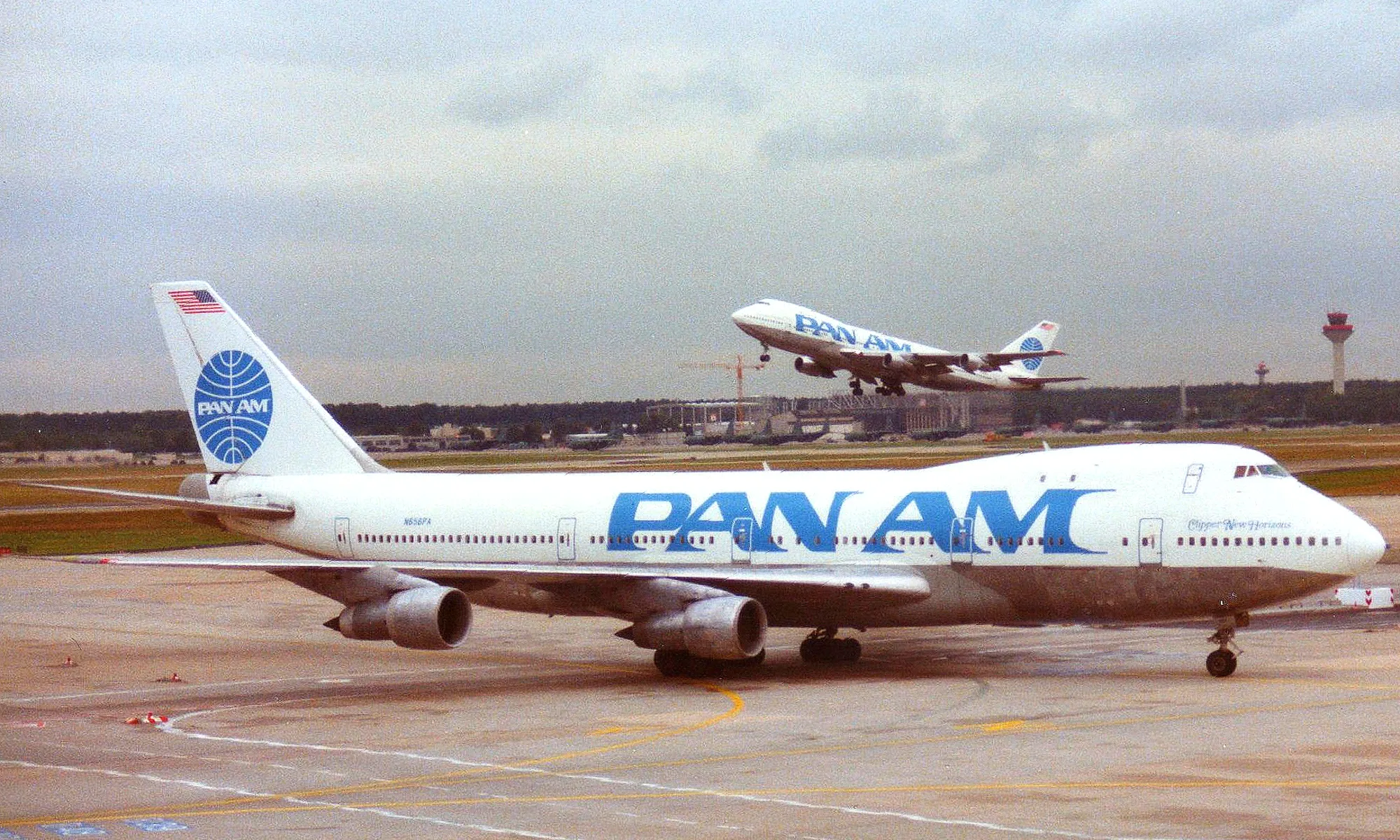
On December 21, 1988, Pan Am Flight 103 took off from London Heathrow Airport headed for New York. Thirty-eight minutes later, a bomb hidden inside a Toshiba radio cassette player detonated in the cargo hold at 31,000 feet. The plane broke apart over Lockerbie, Scotland. All 259 people on board were killed. Eleven more died on the ground when burning wreckage fell on their homes.
Three years, Pan Am was gone.
The question that has ever since is a simple one: did Lockerbie doom Pan Am, or did it just finish off something that was already struggling?
The Hook: America’s Airline
To understand what was lost, you have to understand what Pan Am actually was.
Founded in 1927, Pan American World Airways was not just an airline. It was a symbol. At a time when international travel was reserved for diplomats and the very wealthy, Pan Am made the world feel reachable. Its Boeing 314 Clipper connected continents in the 1930s and 1940s. Its stewardesses were trained like diplomats. Its terminals were designed by architects. When you flew Pan Am, you were flying the American idea of the future.
In 1958, Pan Am became the first US airline to operate transatlantic jet service, flying a Boeing 707 from New York to Paris. It later launched 747 service in 1970, again ahead of the curve. At its peak, Pan Am flew to 86 countries. It trained astronauts how to think about space travel. It had a waiting list for seats on a future commercial flight to the moon.
This was not a struggling regional carrier. This was an institution.
The Intrigue: It Was Already Bleeding
Here’s where things get complicated.
By the time Flight 103 went down, Pan Am was already in serious financial trouble. The problems stretched back almost a decade and came from several directions at once.
Deregulation hit them hardest. The Airline Deregulation Act of 1978 removed the government protections that had essentially guaranteed Pan Am its international routes. Suddenly every airline could fly anywhere. The monopoly Pan Am had built its entire business model on evaporated overnight. Airlines that had been built for domestic competition, like American and United, could now chase Pan Am on its most profitable international routes with lower cost structures.
The National Airlines acquisition was a disaster. In 1980, Pan Am paid around 400 million dollars to acquire National Airlines, which gave it domestic routes for the first time. The logic made sense on paper. If deregulation opened up international routes to domestic carriers, Pan Am needed domestic routes to feed its international hubs. In practice, the merger was a mess. Cultures clashed, the costs ballooned, and Pan Am ended up with a domestic network it didn’t know how to run competing against airlines that had been doing it for decades.
Fuel costs and currency swings hit international carriers disproportionately through the late 1970s and 1980s. Pan Am had more exposure than almost anyone.
By the mid-1980s Pan Am was selling assets just to stay afloat. It sold its iconic Pan Am Building in New York in 1981. It sold its entire Pacific routes to United Airlines in 1985 for $1 billion dollars - which sounds like a windfall before considering those were some of the most valuable routes in the world. Pan Am let them go because it needed cash immediately.
By 1988, before the Lockerbie tragedy, Pan Am had already been bleeding for a decade.
The Mystery: Did Someone Know?
Here’s where the questions start.
In the weeks before Flight 103, a credible warning about a bomb threat against a Pan Am flight was circulated to US embassies. Embassy staff in Helsinki and Moscow were quietly warned. Some chose not to fly Pan Am that holiday season. The traveling public was told nothing.
Pan Am’s own post-crash investigation, led by former CIA and FBI investigators, concluded that US and German intelligence had advance knowledge of a specific plot and failed to act on it. The official US government response was to dispute those findings.
The question of who actually built and planted the bomb took years to resolve officially. In 2001, a Libyan intelligence officer named Abdelbaset al-Megrahi was convicted by a Scottish court. He maintained his innocence until his death in 2012. Some investigators, including members of the original prosecution team, later expressed doubts about whether the right person had been convicted.
The families of victims have spent decades pushing for a full accounting. As recently as 2024, new legal proceedings in Scotland have been examining whether the full truth has ever been told.
Whether Pan Am was targeted because of its American identity, or because of alleged US intelligence operations it had been used to support, or simply because it was a high profile target, has never been definitively answered.
The What-If: Would Pan Am Have Survived?
This is the question ongoing.
The honest answer is probably not, but Lockerbie accelerated the end by years and made a recovery impossible.
After the bombing, passenger bookings collapsed. People were terrified to fly Pan Am specifically. The airline lost an estimated 150 to 200 million dollars in revenue from cancelations in the months after Lockerbie. That was on top of the liability from the crash itself, which eventually resulted in settlements to victims families totaling hundreds of millions of dollars.
Pan Am tried to restructure. It attempted to spin off its transatlantic routes, it sought new investors, it filed Chapter 11 in January 1991 and tried to operate a smaller airline out of Miami. But the capital never came together. On December 4, 1991, exactly three years and two weeks after Lockerbie, Pan Am flew its last flight.
A financially healthy Pan Am might have survived Lockerbie. A financially stressed Pan Am could not absorb the catastrophic blow to both its balance sheet and its public reputation at the same time.