What Really Happened to Blockbuster? The $50 Million Mistake That Changed Everything
Blockbuster built a Netflix rival that was actually working. Then its own investors killed it. The real story of how Blockbuster was destroyed from the inside.

By Vanished Brands Research Desk
In the year 2000, Netflix was a struggling DVD-by-mail startup burning through cash and losing customers to a company called Walmart that had just entered the online rental market. Reed Hastings flew to Dallas to meet with Blockbuster’s executive team with a proposal: let Netflix run Blockbuster’s online operation, and in exchange Netflix would promote Blockbuster stores to its subscribers. The price was somewhere around 50 million dollars.
Blockbuster’s team laughed them out of the room.
That meeting has become one of the most retold stories in business history, usually deployed as a parable about corporate arrogance and the dangers of ignoring disruption. But the real story of how Blockbuster died is more complicated and more interesting than that meeting suggests. Blockbuster did not fail simply because it missed Netflix. It failed because the people inside it who understood the threat and tried to respond were systematically stopped by the people who controlled the money.
What Blockbuster Actually Was
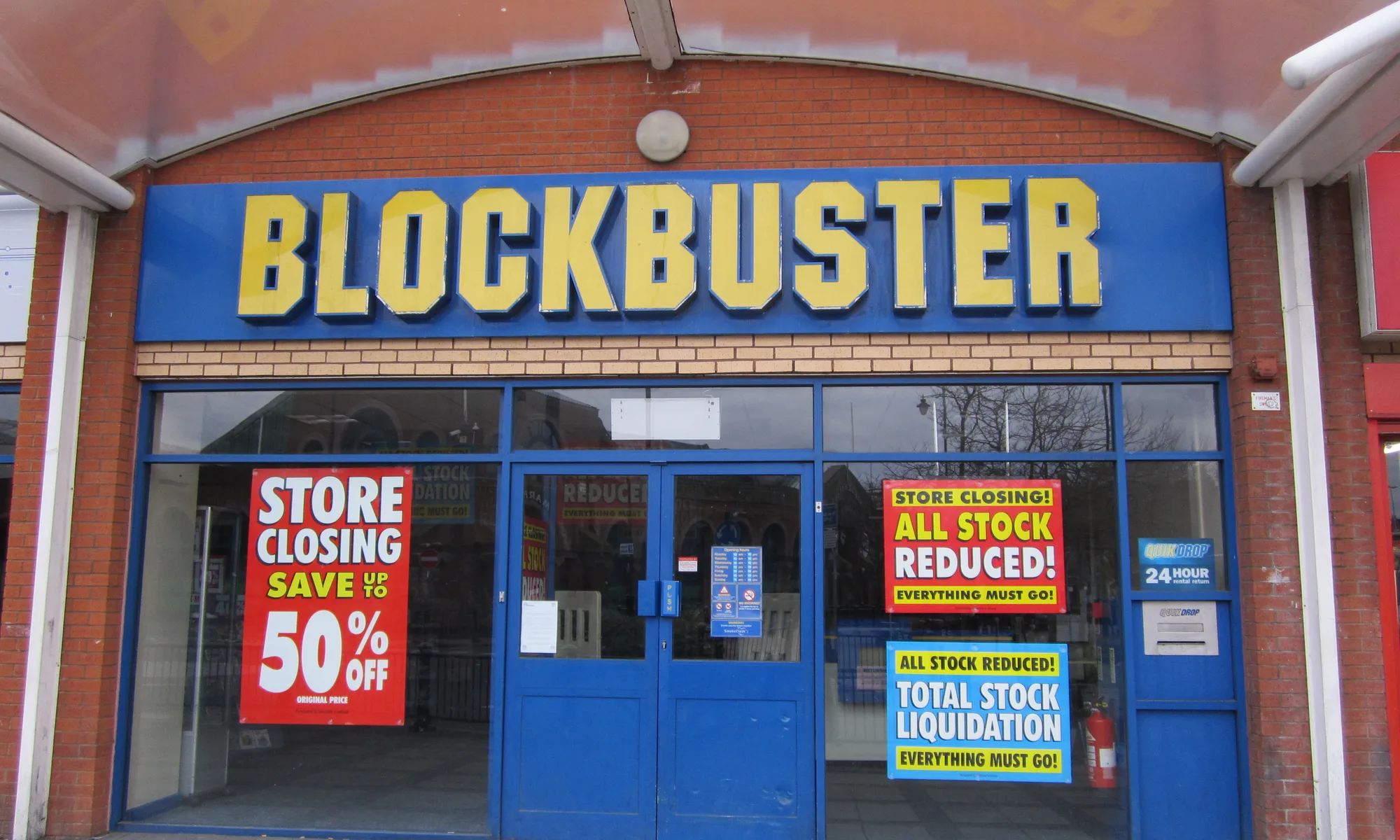
At its peak in the mid-2000s Blockbuster operated over 9,000 stores worldwide and employed approximately 60,000 people. It was the dominant force in home video rental with a brand recognition that was nearly universal in the United States. The blue and yellow sign was a landmark in suburban strip malls the same way a McDonald’s arch was a landmark on a highway.
The business model had a specific characteristic that became central to its eventual collapse. Late fees. Blockbuster charged customers for returning movies after their due date and that revenue stream had become a significant portion of the company’s income. By some estimates late fees were generating around 800 million dollars a year at the peak.
Customers hated late fees with an intensity that is difficult to overstate. It was the single most common complaint about Blockbuster and the grievance that made people most willing to switch to an alternative the moment one appeared. Reed Hastings has said in interviews that his frustration at being charged a 40 dollar late fee on a copy of Apollo 13 was part of what inspired him to found Netflix. Whether that story is literally true or somewhat embellished, it captures something real about the emotional relationship customers had with Blockbuster’s business model.
The Moment That Should Have Changed Everything
The 2000 meeting with Netflix was not Blockbuster’s only chance to respond to the threat of online rental. It was simply the most dramatic early signal that a different kind of competitor was emerging.
What happened in the years after that meeting is less well known. John Antioco, who had been Blockbuster’s CEO since 1997, understood that the business needed to change. He launched Blockbuster Online in 2004 as a direct Netflix competitor, offering DVD-by-mail rental with no late fees and a feature called Total Access that Netflix could not match: subscribers could return online rentals to physical stores and get an immediate in-store rental while they waited for their next mail delivery.
Total Access was genuinely better than Netflix on several dimensions. It combined the convenience of mail-order with the immediacy of in-store rental in a way that Netflix could not replicate because Netflix had no stores. By 2007 Blockbuster Online was adding subscribers at a rate that alarmed Netflix executives. Reed Hastings later acknowledged that Total Access threatened to undermine Netflix’s business model at a fundamental level.
Blockbuster was also eliminating late fees across its store network, directly addressing the primary reason customers had grievances against the brand. Antioco’s plan was working. Then his board removed him.
The Villain of the Story
Carl Icahn is one of the most famous activist investors in American financial history. He takes large positions in companies he believes are undervalued or mismanaged, pushes for changes that increase short-term stock price, and moves on. His involvement with Blockbuster beginning in 2004 followed a familiar pattern.
Icahn and other activist investors on the board pushed back hard against Antioco’s strategy. Their argument was that eliminating late fees cost the company 400 million dollars in annual revenue without a guaranteed return, and that Blockbuster Online was expensive to operate and taking too long to become profitable. From a short-term financial perspective those criticisms were not wrong. Antioco was spending significant money on a strategy whose payoff was measured in years rather than quarters.
The conflict came to a head over Antioco’s compensation package. Icahn led a shareholder campaign against the bonus structure and the dispute became a proxy war over the entire strategic direction of the company. Antioco left in 2007 after the board sided with the investors.
His replacement was Jim Keyes, who had most recently served as CEO of 7-Eleven. Keyes came from a convenience store background and approached Blockbuster through that lens, focusing on in-store product mix, store economics, and operational efficiency. In 2008 he told an interviewer that neither Netflix nor Redbox were on his radar screen as competitive threats.
Two years later Blockbuster filed for bankruptcy.
What Keyes Got Wrong
The Keyes era is often portrayed as simple incompetence, a man who did not understand the industry he had been handed. The reality is more structural than that.
Keyes was brought in specifically because the board and investors wanted a different strategy than Antioco’s. His job was not to compete with Netflix. His job was to make Blockbuster’s existing store model profitable again by cutting costs and improving operations. He was executing the strategy the investors had demanded by removing Antioco.
The problem was that the investors had misread what was actually happening in the market. They saw Antioco spending money on an online strategy that had not yet turned a profit and concluded he was making a mistake. What they did not see, or chose not to see, was that the mail-order and streaming model was not a temporary trend that Blockbuster could wait out. It was a permanent shift in how people wanted to consume video content.
Blockbuster Online had approximately three million subscribers when Antioco left. Netflix had around 6.3 million. The gap was closeable. Total Access was the right product. The money being spent on it was an investment in the only viable future the company had.
By the time Keyes reversed course and tried to take Blockbuster’s online strategy seriously, Netflix had grown far beyond the point where Blockbuster could catch it. The window had closed.
The $50 Million Question
Would Blockbuster have survived if it had bought Netflix in 2000?
Almost certainly not in the form that it existed then. The physical store network would still have faced the same structural pressures regardless of who owned the streaming infrastructure. But owning Netflix would have given Blockbuster a position in the future of video distribution rather than no position at all. It would have been a very different company by 2010, but it might have been a company.
The more interesting counterfactual is not the 2000 meeting but the 2007 board decision. If Antioco had been allowed to continue executing Total Access, Blockbuster Online might have reached profitability and built the subscriber base needed to fund a genuine transition away from physical stores. The technology and the product were in place. The strategy was working. The interference came from within.
Blockbuster’s collapse is usually taught as a lesson about the dangers of ignoring external disruption. The more precise lesson is about the dangers of short-term investor pressure applied at the moment when a company most needs to spend money on its future. Blockbuster saw Netflix coming. It built a competitor. Its investors decided the competitor was too expensive and removed the person running it.
That is a different kind of failure than simple blindness, and it is a much more common one.
What Remained
Blockbuster filed for Chapter 11 bankruptcy in September 2010. DISH Network acquired the brand assets in a bankruptcy auction in 2011 for approximately 320 million dollars and attempted a hybrid retail and streaming strategy before closing the remaining corporate stores in 2013 and 2014.
One Blockbuster remained open after all the corporate locations closed. The franchise location in Bend, Oregon operated independently throughout the corporate collapse and remains open today as of 2025. It has become a genuine cultural landmark, a nostalgia destination that draws visitors from across the country and has been the subject of documentaries, news features, and social media content that has kept the Blockbuster name alive long after the company itself ceased to exist.
The last Blockbuster rents DVDs and video games and sells branded merchandise. It is staffed by people who understand that they are operating a museum as much as a video rental store. The owner, Sandi Harding, has described it as a community gathering place that happens to have the Blockbuster name on it.
It is a strange and fitting end for a brand that was once the most powerful force in home entertainment. One store. Bend, Oregon. Still open.
Frequently Asked Questions
Did Blockbuster really have a chance to buy Netflix for 50 million dollars? The meeting happened and the offer was in that range, though the exact figures have been described differently in various accounts. Netflix was in a genuinely difficult financial position in 2000 and a deal at some price was plausible. Blockbuster’s executive team declined without serious consideration.
Was Blockbuster Online actually competitive with Netflix? Yes, and briefly it was arguably better. Total Access, which let subscribers return online rentals to physical stores, was a feature Netflix could not replicate. By 2006 and 2007 Blockbuster Online was growing rapidly and Netflix executives acknowledged the threat internally.
Who was responsible for Blockbuster’s failure? The most specific answer is that the board and activist investors including Carl Icahn removed the CEO who was executing a workable competitive strategy and replaced him with someone whose mandate was to cut costs rather than compete on the future of the business.
Is there really still a Blockbuster open? Yes. The franchise location in Bend, Oregon has remained continuously open and as of 2025 is the last operating Blockbuster in the world. It rents DVDs and games and sells merchandise.
What did Netflix think of Blockbuster Online? Reed Hastings and other Netflix executives have said in interviews and in the Netflix documentary that Total Access genuinely worried them. It was the most serious competitive threat Netflix faced in its early years.
Related reading: What Happened to Blockbuster?